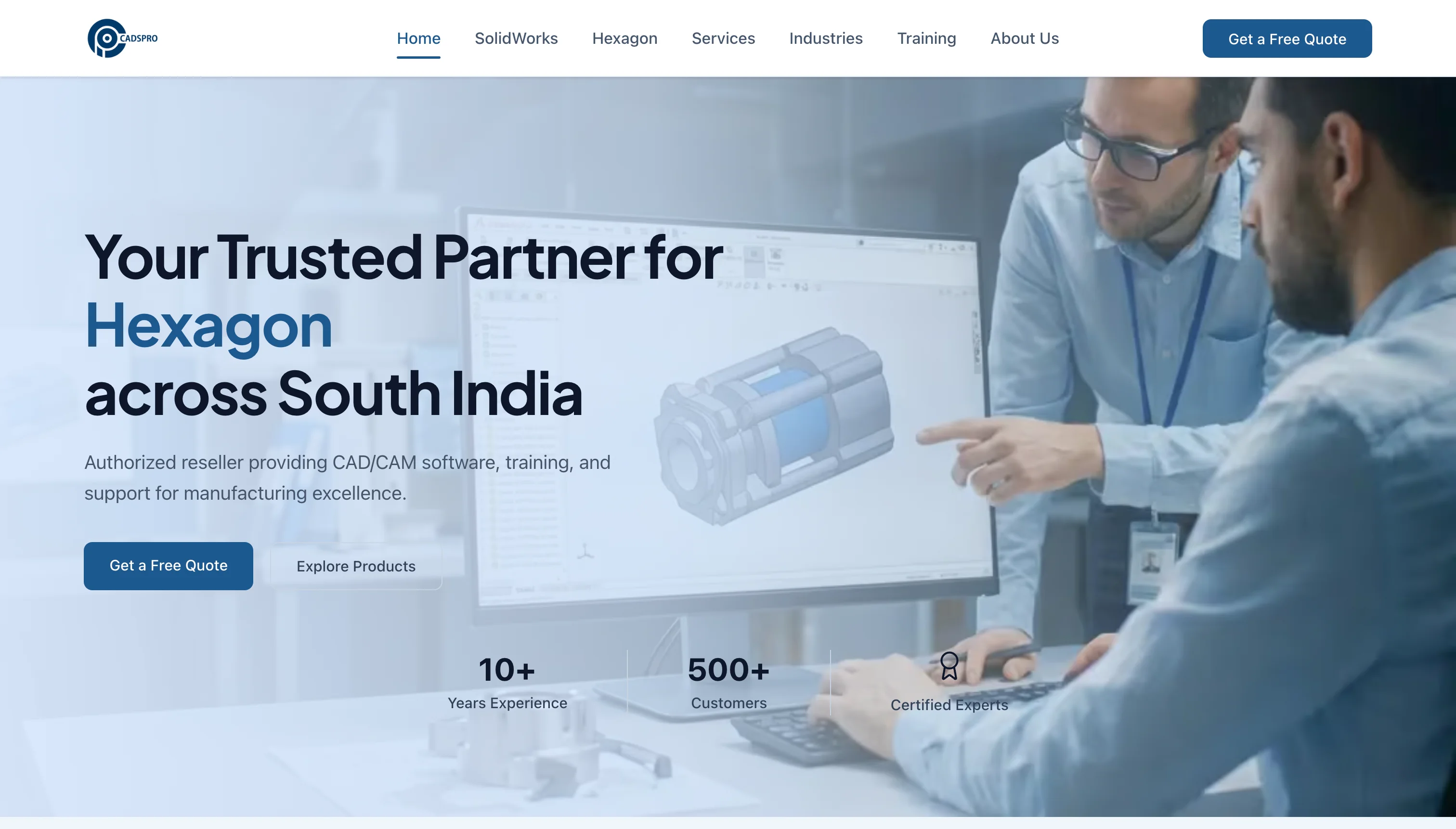
A SaaS landing page has one job: convert visitors into signups or demo requests. Yet most SaaS landing pages bury their value proposition, overwhelm visitors with features, and fail to build enough trust to justify sharing an email address. After building landing pages for dozens of SaaS companies, we've identified the patterns that consistently drive conversions — and the mistakes that kill them.
The Proven Landing Page Structure
High-converting SaaS landing pages follow this section order:
- Hero: Clear headline stating the outcome (not the product), subheadline with specifics, primary CTA, and a product screenshot or demo video
- Social proof bar: Logos of recognizable customers, user count, or notable press mentions — placed immediately below the hero
- Problem agitation: Describe the pain your audience feels in their own language, making them feel understood before you pitch the solution
- Solution overview: Three to four key capabilities with brief descriptions and supporting visuals — focus on outcomes, not features
- Detailed features: Expandable sections or tabs for visitors who want to go deeper into specific capabilities
- Testimonials: Real quotes from real customers with names, photos, companies, and specific results achieved
- Pricing: Transparent pricing builds trust — if you hide your pricing, you lose a significant percentage of qualified leads
- FAQ: Address the top five objections that prevent signups — security, integrations, migration, support, and contracts
- Final CTA: Restate the core value proposition and provide a low-friction signup path
Copy Principles That Convert
Lead with the outcome, not the mechanism. Don't say 'AI-powered project management platform' — say 'Ship projects 3x faster with half the meetings.' Use specific numbers whenever possible. Social proof should be quantified: '12,000 teams' hits harder than 'thousands of teams.' Write at a sixth-grade reading level; clarity beats cleverness every time. And front-load your value — the first three words of every headline should carry meaning.
Design Patterns That Work
Keep your hero section focused — one headline, one CTA, one visual. Use whitespace generously; crowded layouts signal low quality. Product screenshots should show the actual UI with realistic data, not empty-state mockups. Use animation sparingly and purposefully — a subtle entrance animation on the hero is fine, but a page full of bouncing elements is distracting. Your CTA buttons should use high-contrast colors and action-oriented text: 'Start free trial' outperforms 'Sign up' by 20-30% in A/B tests.
Technical Performance Matters
A one-second delay in page load reduces conversions by 7%. Build your landing page with performance in mind: use Next.js with static generation, optimize images with WebP/AVIF formats, lazy-load below-the-fold content, and minimize third-party scripts. We build our SaaS landing pages in either Webflow for rapid iteration or Next.js with Framer Motion for custom interactions, always targeting sub-two-second load times on 3G connections.
The best SaaS landing pages don't feel like marketing — they feel like a conversation with someone who deeply understands your problem and has built the perfect solution.
Finally, treat your landing page as a living experiment. Set up analytics tracking on every CTA click and scroll depth marker. Run A/B tests on your headline, hero image, and CTA text. Review session recordings to see where visitors hesitate or drop off. The first version of your landing page is a hypothesis — optimization is where the real conversion gains happen.