
Ask most Indian exporters how they find overseas buyers and you'll hear the same three answers: IndiaMART, trade fairs, and a cousin who knows someone in Dubai. All three work, occasionally. None of them scale, and none of them are working while you sleep. Meanwhile a procurement officer in São Paulo is searching for exactly what you sell — and finding a competitor. This guide covers the channels that actually produce buyers, how to check those buyers are real, and how to get paid once they are. For done-for-you help, see our digital marketing for export companies.
Key takeaways:
- Buyers move through three stages — discovery, shortlisting, verification. Most Indian exporters are only visible during the last two, which is why they end up competing on price.
- The highest-leverage channels are export promotion councils, trade data platforms, and your own website. The first two are cheap; the third is the only one you own.
- Publishing your site in your buyer's language is the most underused tactic in Indian export marketing, because almost every competitor publishes in English only.
- Verify every buyer before shipping: company registration, trade references, an import licence for your category, and a small trial order first.
- Payment terms are a risk decision, not an admin step. Advance payment and letters of credit protect you; open account is how exporters lose money.
Where international buyers actually look for suppliers
A foreign buyer sourcing from India generally moves through three stages, and most exporters are only visible during one of them.
- Discovery — they don't know who supplies this yet. They search, in their own language, for the product, the specification, or the problem. This is where almost every Indian exporter is invisible, and where the most valuable relationships start.
- Shortlisting — they have three or four names and they're checking credibility. They look for your website, your certifications, your export registrations, evidence you've shipped to their region before.
- Verification — they want documentation, compliance paperwork, and a human who replies. This is where directories and referrals do their work.
Directories like IndiaMART and Alibaba serve stages two and three well. They are a poor place to win stage one, because on a directory you are one of four hundred near-identical listings competing on price alone. Search is the opposite: if a buyer finds you while they are still defining what they need, you shape the specification instead of bidding against it.
The channels that actually produce export buyers
Start with the ones that cost the least and require no technology. Most exporters skip these because they are unglamorous, then spend money on advertising instead.
- Export Promotion Councils — sector-specific and government-recognised. APEDA for agricultural and processed food, GJEPC for gems and jewellery, EPCH for handicrafts, EEPC for engineering goods. Membership gets you into buyer-seller meets, trade delegations and their buyer directories. This is the cheapest qualified-buyer access an Indian exporter has.
- FIEO and the trade bodies — the Federation of Indian Export Organisations is the apex body, alongside TPCI, CII and ASSOCHAM. FIEO registration is also a credibility marker overseas buyers recognise.
- Government portals — DGFT's Trade Connect ePlatform lists export opportunities and verified buyers. The Indian Trade Portal gives you tariffs by HS code for 90-plus countries. TRADESTAT holds India's own export-import data bank. All free.
- Trade fairs and exhibitions — Canton Fair for consumer goods, Gulfood in Dubai for processed food, Heimtextil in Germany for home textiles. Book through ITPO or your council, and collect the exhibitor directory even if you do not take a stall.
- Trade data platforms — Volza, ImportGenius, Panjiva and Trademo let you search actual shipment records by HS code and find the companies already importing what you make. This is the most underrated prospecting method available.
- Country trade directories — Kompass and ThomasNet for industrial buyers, Europages for Europe. Filter by category and country.
- Foreign trade promotion agencies — JETRO in Japan, TAITRA in Taiwan. These exist to help their own importers find suppliers, and many maintain directories Indian exporters can be listed in.
- Indian embassies and commercial wings — trade attachés in your target country often hold lists of vetted local importers and will make introductions. Almost nobody asks.
- Direct outreach — LinkedIn Sales Navigator to find procurement and sourcing titles, Hunter.io or Apollo.io to verify email addresses. Expect low response rates, which is exactly why inbound matters.
Work through that list and you will generate leads. But every one of those channels is a list you rent or a room you visit. The only asset you own is your website — and it is the one most Indian exporters treat as a brochure.
Why an English-only website loses non-English buyers
Here's the assumption that costs Indian exporters the most money: "our buyers are procurement professionals, they all read English." Many of them do. But reading English and searching in English are completely different behaviours. A hospital administrator in Brazil who is perfectly capable of reading your English spec sheet will still type her search in Portuguese, because that is the language she thinks in. If you have no Portuguese page, you were never in that search result. She never rejected you — she never saw you.
This is not about translation quality. It is about existence. Google serves results in the searcher's language. A site with only English pages competes only for English searches, which for a business selling into Latin America, Francophone Africa, the Gulf or the Lusophone world means competing for a small fraction of the actual demand.
Almost every Indian exporter publishes in English only. That is not a problem to complain about — it is the opening.
What a genuinely multilingual export site involves:
- Real URL paths per language, not a Google Translate widget. A widget translates text for a visitor who already found you; it does nothing to make you findable. You need indexable pages at their own addresses — /en/, /es/, /fr/, /ar/ — that Google can crawl and rank independently.
- Correct hreflang annotations so Google knows these are alternates of each other and serves the right one to the right country, rather than treating them as duplicate content.
- Localised, not translated, commercial terms — the literal Spanish translation of your product name is frequently not what Spanish-speaking buyers type. More on this below.
- Native-language enquiry handling — there is no point ranking in French if the contact form replies in English three days later. Decide in advance who answers, and how fast.
Keyword research in your buyer's language, not translated from English
This is the step almost everyone gets wrong, including agencies. The usual process is: build an English keyword list, run it through translation, publish. It fails because search language is cultural, not literal. Buyers in different markets use different words for identical products — regional trade terminology, borrowed English words that stuck, brand names that became generic, local regulatory vocabulary. The correctly translated term and the actually searched term are often two different phrases, and only one of them has volume.
The process that works is to research each language market natively: pull real volume data for that country and language, look at what the ranking pages in that market actually say, and read the People Also Ask questions in that language. You find terms with genuine demand that a translation would never have produced — and you frequently find that competition in Portuguese, French or Arabic is a fraction of what it is in English.
One practical consequence: your language markets should not get identical page structures. If Francophone buyers are searching a specification and Spanish-speaking buyers are searching a use case, those need different pages, not mirrors of the same one.
Why page speed decides whether emerging-market buyers ever see your site
Export marketing has a technical problem that domestic marketing does not: your buyers are frequently on worse connections than you are. A procurement manager in Kinshasa, Lagos or Lima is often on mobile, often on a congested network, often on a mid-range Android device. A site that feels fine on office fibre in Bengaluru can be genuinely unusable there — and unusable means they leave before your value proposition ever renders.
The three metrics that matter, and what they mean in an export context:
- LCP (Largest Contentful Paint) — how long until the main content appears. Target under 2.5 seconds. On a slow mobile connection this is the metric that decides whether a buyer waits or bounces, and hero images are usually the culprit.
- INP (Interaction to Next Paint) — how fast the page responds when tapped. Target under 200ms. Relevant the moment a buyer tries to open your product categories or start an enquiry form.
- CLS (Cumulative Layout Shift) — whether content jumps around as it loads. Target under 0.1. A buyer who taps 'Request Quote' and hits something else because the layout moved is a lost enquiry.
Lighthouse scores are a useful diagnostic, but audit the pages buyers actually land on, not the homepage you show clients. A perfect score on the front page means little if your deep specification pages — the ones that rank for the searches that matter — are the slow ones. We go deeper in our Core Web Vitals playbook.
The SEO that actually reaches procurement teams
Export SEO differs from local SEO in one important way: there is no map pack to win and no 'near me' to rank for. Your buyer is eight thousand kilometres away and proximity is irrelevant. What matters instead is specification depth, credibility signals, and answering the questions a buyer asks before they are ready to talk to anyone.
- Build pages around specifications, not catalogue categories — buyers search for the exact thing: a capacity, a standard, a certification, a configuration. A page per specification outranks a single page listing forty products.
- Put your export credentials where they can be read and indexed — IEC, FIEO membership, export promotion council registration, and the compliance documentation your manufacturers hold. For an overseas buyer taking a risk on an unknown Indian supplier, these decide the shortlist.
- Answer the pre-purchase questions on your own site — how shipping works, what payment terms you accept, what happens at customs, what after-sales support exists at distance. Exporters leave these for the email thread; the ones who publish them get found and get trusted.
- Write for AI answer engines, not just blue links — more buyers now start with ChatGPT, Perplexity or a Google AI Overview. Getting cited requires answer-first content: a question as a heading, the answer in the first two sentences, no throat-clearing.
That last point is worth dwelling on. In our own client data, traffic arriving from AI assistants converts at a dramatically higher rate than traffic from paid search — a visitor who arrives because an AI recommended you has already been pre-qualified by the recommendation. It is currently a small channel for most exporters and a badly underrated one.
Paid search in your buyer's language
SEO compounds but it is slow. Google Ads buys you presence in a market immediately, which makes the two complementary rather than alternative: ads tell you within weeks which markets and which phrasings produce real enquiries, and that evidence tells you where to point the slower SEO work.
The structure that works for exporters is one campaign per language market rather than one global campaign. Separate campaigns let you bid differently where competition is thin, control budget per market, and send each market to a landing page in its own language. Sending a Portuguese-language ad to an English landing page wastes the click entirely. Budget realism matters too: several language markets running simultaneously on a small daily budget means every campaign is throttled and none produces conclusive data. Fund fewer markets properly rather than all of them badly.
How to check an international buyer is genuine
This is the question exporters ask most often, and for good reason — the downside is an unpaid container. Run every new buyer through the same checks before you ship anything, regardless of how enthusiastic the enquiry sounds.
- Company registration — ask for registration documents and verify them against the public companies registry in their country. A buyer who cannot produce these is not a buyer.
- Import licence — confirm they are actually licensed to import your product category. Plenty of genuine companies are not.
- Trade references — ask for two previous suppliers and contact them about payment behaviour. A buyer who resists giving references is telling you something.
- Physical presence — check the address exists and matches the business. A warehouse or office you can find on a map, a landline, a company domain rather than a free email account.
- Start with a sample or trial order — this tests their willingness to pay, their logistics capability and their communication reliability at minimal risk. Refusing a trial order without good reason is a red flag worth taking seriously.
- Match the paperwork — the company on the purchase order, the consignee on the shipping documents and the party making payment should all be the same entity. When they are not, ask why before you proceed.
One useful side effect of inbound marketing: buyers who find you through search and enquire after reading your specification pages tend to be better qualified than directory leads, because they have already self-selected on fit before making contact.
Getting paid: the risk most first-time exporters underestimate
Finding a buyer is half the job. Your payment terms decide whether the order makes you money or costs you a container, and this is a commercial decision rather than a piece of paperwork to hand to your bank.
The four common arrangements, ordered from safest to riskiest for you:
| Payment term | How it works | Risk to the exporter |
|---|---|---|
| Advance payment | Buyer pays in full or in part before dispatch, usually by wire transfer. | Lowest. Buyers often resist it, especially on a first order. |
| Letter of credit (LC) | The buyer's bank guarantees payment once you present compliant shipping documents. | Low, but bank fees and strict document requirements apply. A discrepancy can delay payment. |
| Documentary collection | Banks release shipping documents against payment (D/P) or against acceptance of a time draft (D/A). | Moderate. D/P is safer than D/A, since D/A hands over the goods before money changes hands. |
| Open account | You ship first and invoice on 30 to 90 day terms. | Highest. Reasonable only with a long-standing buyer, or with credit insurance behind it. |
Two costs exporters routinely forget to price in: currency movement between agreeing a price and receiving funds, and the spread your bank takes on conversion. On thin margins these can remove the profit from an otherwise good order, so quote with them in mind rather than discovering them at settlement.
Why most exporters struggle to find buyers
The pattern is remarkably consistent, and it is almost never the product.
- They are only visible at the shortlisting stage, so every conversation starts as a price comparison against four other suppliers.
- They publish in English and assume the world searches in English, which silently removes them from the majority of relevant searches in their best markets.
- They chase eight countries at once on a budget that can properly support two, so no market ever gets enough investment to produce conclusive results.
- They treat the website as a brochure to be shown rather than an asset to be found, so it is never structured around what buyers actually search for.
- They respond slowly. An enquiry from a different timezone that sits unanswered for two days has usually gone to a competitor.
Common mistakes to avoid
| Mistake | Why it costs you | What to do instead |
|---|---|---|
| Translating your English keyword list | The translated term and the searched term are usually different phrases; only one has volume. | Research each language market natively, with real volume data for that country. |
| Using a translation widget | It converts text for visitors who already arrived. It creates nothing for Google to index or rank. | Publish real indexable pages per language, with correct hreflang. |
| Skipping buyer verification | An unpaid container costs more than every marketing decision on this page combined. | Registration check, trade references, import licence, trial order. |
| Open account terms on a first order | You ship the goods and hold all of the risk, with no leverage if payment is late. | Advance payment or a letter of credit until the relationship is proven. |
| Spreading budget across too many markets | Every campaign is throttled and none produces data you can act on. | Fund two or three markets properly, then expand on evidence. |
| Slow enquiry response | Buyers in other timezones move on. Speed is a competitive advantage that costs nothing. | Decide who answers, in what language, within what window. |
Case study: TMR Medical
TMR Medical is a Bengaluru-based medical equipment supplier and exporter — ICU and operating theatre equipment, diagnostic imaging, laboratory systems, hospital furniture — supplying healthcare facilities across India and more than fifteen export markets, with FIEO registration, an Importer-Exporter Code and Pharmexcil membership behind them. Their challenge was the one described above: a credible export business whose online presence spoke only English, while a large share of their addressable buyers — across Latin America, Francophone Africa and the Gulf — were never searching in English at all.
What we built:
- A multilingual site architecture with dedicated indexable paths per language rather than a translation overlay, so each market's pages could rank on their own merits.
- Native keyword research per language market, researching Spanish, French and Arabic demand directly instead of translating an English list — which surfaced both the real search terms and how much thinner the competition was in those languages.
- Specification-level pages and export credibility signals built for buyers shortlisting an unfamiliar overseas supplier.
- Language-segmented Google Ads, one campaign per market, each pointed at a landing page in the buyer's own language.
The clearest evidence that the approach is working is the geography of the traffic. This is a business headquartered in Bengaluru, and not one of its seven largest source countries is India. The visitors come from Argentina, Peru and Colombia, from Nigeria and the Democratic Republic of the Congo, from Singapore — and most of all from Brazil. That is what it looks like when a site stops being a domestic brochure and starts being findable in the markets it actually sells to.
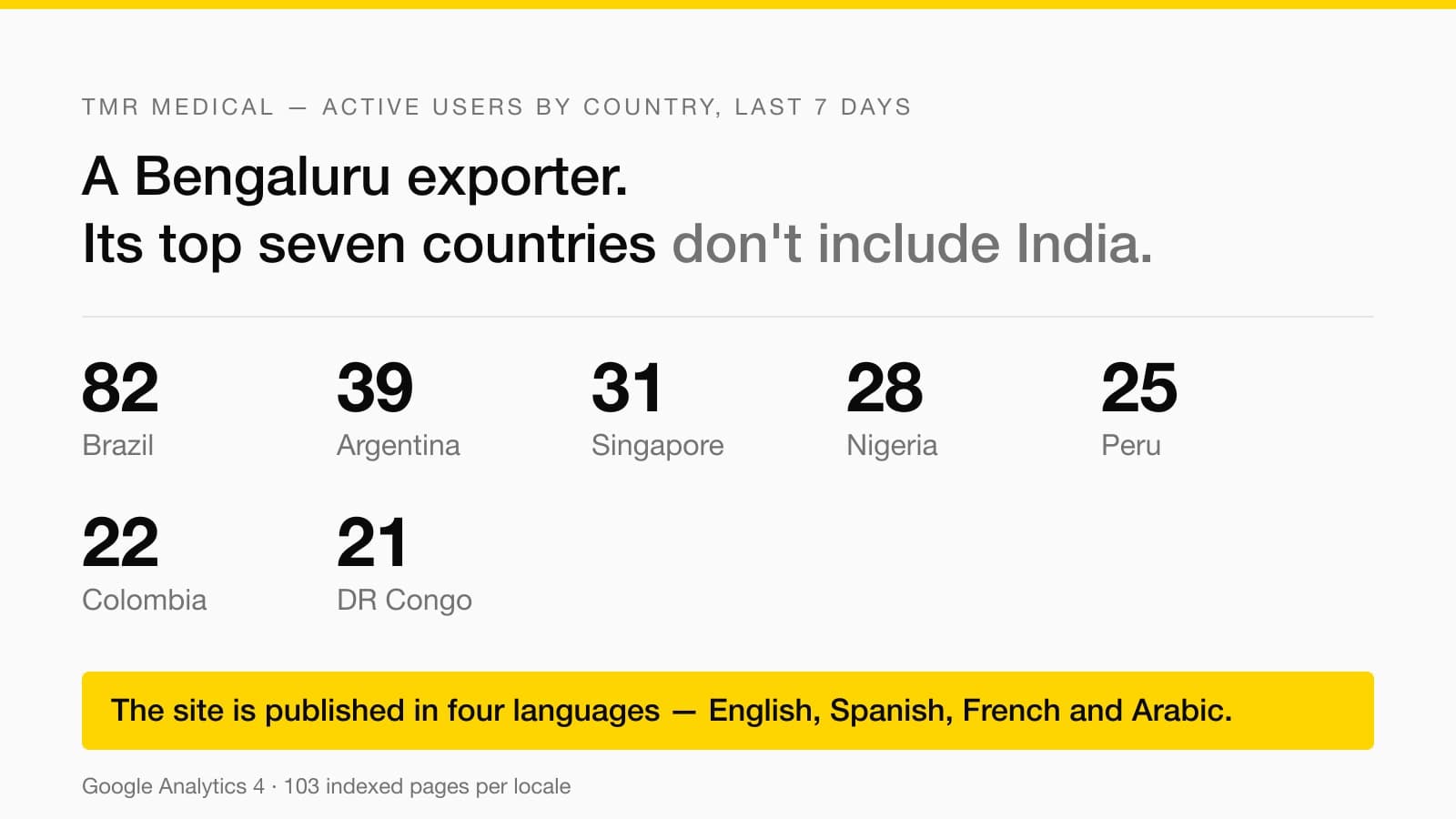
Spanish and French product pages now rank on the first page of results in their own markets. Organic sessions engage substantially longer than paid ones, which is what you want to see — it indicates the people arriving through search are the right people. You can also see a related build on the import side in our TMR Fino Global case study.
What this costs and how long it takes
Honest timelines, because the alternative helps nobody. Google Ads in a new language market produces meaningful signal in four to eight weeks — enough to know which markets respond. Multilingual SEO is slower: expect three months before pages are indexed and ranking anywhere useful, and six to twelve months before organic becomes a dependable enquiry source. The site build itself is typically six to ten weeks depending on how many languages and how deep the specification catalogue runs.
The sequencing we recommend is to build the multilingual foundation first, run ads into two or three markets to find where demand actually is, then concentrate the SEO investment on the markets the ad data proves out. It is considerably cheaper than committing to eight languages on a guess.
Frequently asked questions
How do I find a genuine buyer rather than a time-waster? Verify before you invest effort: check company registration against the public registry in their country, ask for two trade references, confirm they hold an import licence for your product category, and start with a small trial order rather than a container. Buyers who arrive through search having read your specification pages tend to be better qualified than directory enquiries, because they have already self-selected on fit.
Where can I find a list of export buyers for free? Start with government resources — DGFT's Trade Connect ePlatform, the Indian Trade Portal, TRADESTAT, your relevant Export Promotion Council, and FIEO's buyer-seller meets. Trade data platforms such as Volza, ImportGenius and Panjiva list companies already importing your HS code on paid plans. Treat all of these as prospecting lists, not as a substitute for being findable when buyers search on their own.
How do I contact international buyers once I have identified them? LinkedIn is the most effective direct channel for reaching procurement and sourcing roles, followed by targeted email with your specification documentation attached. Indian embassies and trade attachés in your target country will often make introductions to vetted local importers, and almost nobody asks them. Expect low response rates on cold outreach, which is precisely why inbound matters.
Do I really need my website in multiple languages? If your target markets are Latin America, Francophone or Lusophone Africa, the Gulf or much of Asia, then yes — you are otherwise invisible for the majority of relevant searches in those markets. If you sell exclusively to the US, UK or Singapore, English alone is defensible. The test is simple: look at where your buyers are, and ask what language they would search in.
What is the safest payment method for exports? Advance payment carries the least risk to you, followed by a letter of credit, which balances protection for both sides at the cost of bank fees and strict documentation. Documentary collection against payment is workable; open account terms are the riskiest and are reasonable only with an established buyer or credit insurance behind the order.
How long before multilingual SEO produces enquiries? Three months to see ranking movement, six to twelve months for organic to become a reliable source of enquiries. Paid search in the same languages is the bridge that produces enquiries while the SEO matures.
If you are an exporter whose website only speaks English, that is the gap worth closing first. We build multilingual export sites, run keyword research natively in each target language, and manage the search and paid campaigns that go with them. Get a quote or talk to us about your markets.